Direct-to-Film has stopped being the challenger format. In 2026 it is the largest single segment of digital textile printing, and the equipment market is reorganising around that fact. This article sets out where DTF currently sits against DTG, what a 2026 production machine looks like in technical terms, what a complete entry-level line costs, and what all of it means for print shops and distributors planning capacity.

Global DTF Market Position
Market commentary on DTF is consistent on direction, if not on decimals. The figures that circulate most widely put DTF at roughly 46% of digital textile printing and DTG at roughly 33% — a gap that did not exist when DTG was the default short-run garment option.
The forecasts point the same way: DTF equipment is expected to approach two-thirds of digital textile printing equipment installations by 2027, with 64.4% the most frequently cited figure.
At the finished-garment level, DTF-printed garments are expected to move from roughly one-fifth of the market in 2024 toward 35–40%, taking volume primarily from traditional printing and from lower-end DTG systems.
A note on these numbers: published market data for this segment is fragmented, and the figures above vary by source and by how widely “digital textile printing” is scoped — some counts include soft signage, others do not. Read them as directional indicators of where the segment is heading, not as precise measurements.
DTF Equipment Technical Trends in 2026
Printhead Configuration
Industrial-grade multi-printhead setups are becoming the standard for scaled production. A representative six-head DTF printer runs six Epson i3200 printheads, with the heads split across process colour, white ink and spot colour channels.
At that configuration, output reaches approximately 30 m²/h in 4-pass mode — over 240 m² across an eight-hour shift.
Automation and Integration
Manufacturers are moving away from standalone units toward integrated systems that combine printing, powder shaking and curing into one streamlined workflow.
The driver is labour rather than headline speed. Every manual transfer between printing, powdering and curing adds a handling step, a waiting interval, and one more place for defects to enter the line.
Cost Structure
Budget figures for a complete entry-level DTF system — printer, powder shaker, curing oven, heat press and air purifier — commonly land around USD 10,000 in total.
Within that, entry-level printers are typically quoted in the USD 1,500–3,000 band and mid-range models at USD 5,000–8,000. These are open-market ranges rather than any one supplier’s list pricing, and they shift with printhead count, working width and local duties.
The gap between the printer price and the system price is the part buyers most often under-budget for. The powder shaker, curing and pressing equipment are not optional extras if the line is to run as a line — a printer without matched finishing equipment is not a production system.
What These Trends Mean for Print Shops and Distributors
Three practical readings from the data above:
- The format is no longer experimental. With DTF equipment heading toward two-thirds of all digital textile printing installations, consumables, spare parts and trained operators are becoming widely available. That lowers the risk of committing production to DTF.
- The entry cost is well defined. At roughly USD 10,000 for a complete line, DTF is accessible to small workshops — which is precisely why the segment keeps taking volume from lower-end DTG systems.
- Integration is the differentiator, not head count. As printhead counts converge across brands, the operational gap moves to how well printing, powdering and curing are matched to one another. A well-matched three-station line will out-produce a faster printer that is waiting on its shaker.
Where Yinstar Fits in This Market
Yinstar builds DTF equipment across the range these trends describe — from compact 30 cm machines through to 60 cm multi-head production platforms, each configured with a matching powder shaker rather than sold as a printer on its own.
That pairing matters more than headline print speed. Because powdering throughput is matched to the printer at configuration time, the printer does not end up waiting on its shaker — the mismatch behind most under-used DTF lines.
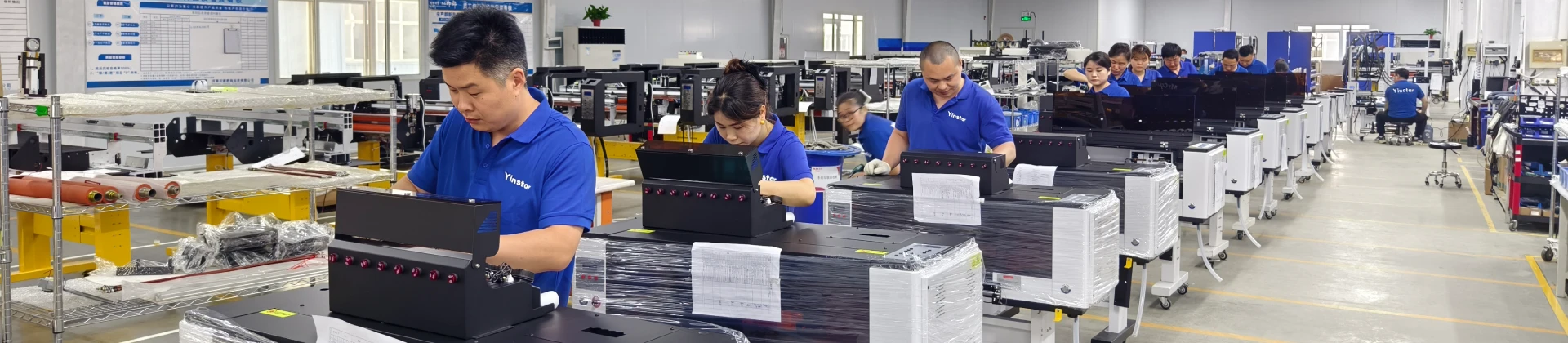
Rather than describe it, here is a Yinstar DTF printer running in production:
For buyers sizing a complete line rather than a single machine, our DTF powder shaker guide explains where powdering and curing sit between printing and heat pressing, and how to match shaker throughput to printer output so the printer never waits.
Browse the full DTF printer range, or see the matching DTF powder and consumables.
Planning a DTF line for 2026? Tell us your target output and the products you print, and we will recommend a matched printer-and-shaker configuration with a full quotation.