
Dye-sublimation printing is a digital process built for polyester and for substrates carrying a polymer coating. Heat turns the ink into gas, the dye bonds into the fibre, and the colour ends up inside the material rather than sitting on top of it. That single mechanical difference explains most of where the process wins — and where it does not.
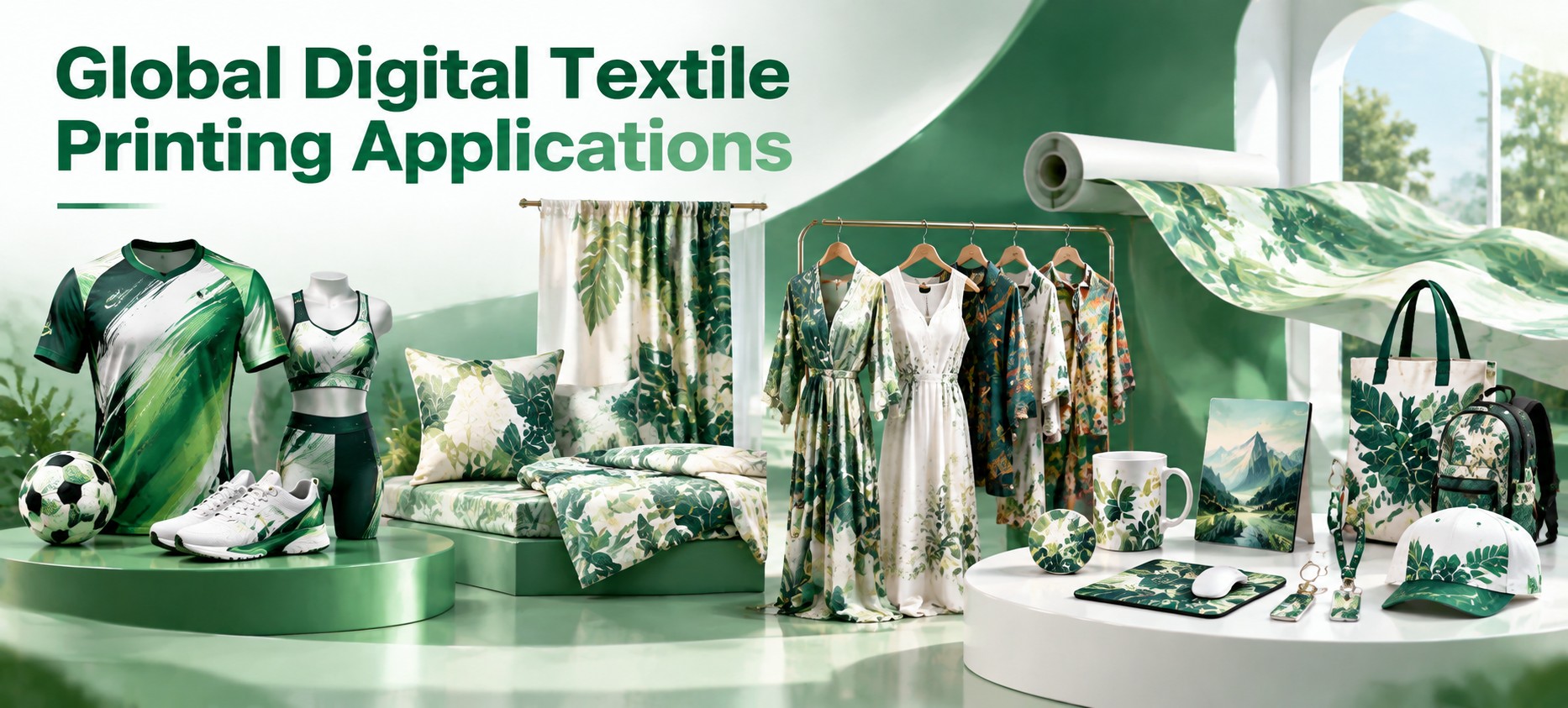
The technology now serves five distinct commercial markets: sportswear and team uniforms, home textiles and interior décor, fashion and all-over fabric printing, personalised gifts and promotional products, and footwear, bags and textile accessories. Each market buys on a different mix of format, throughput and finishing — which is why the machine that suits one is rarely the machine that suits another.
What Dye-Sublimation Printing Does Differently
Because the dye is transferred as a gas and absorbed into the polyester fibre, the print has no raised layer to crack, peel or stiffen the fabric. Gradients, photographic detail and all-over patterns reproduce without the hand-feel penalty that surface-printed textiles carry. The same property makes the process practical for cut-and-sew production: fabric can be printed before it is cut, so artwork runs continuously across the roll instead of being framed inside a single garment panel.
The limitation is just as specific. The process needs polyester or a treated surface. Untreated cotton and natural fibres do not accept sublimation dye — those need a different chemistry. A buyer planning to serve both polyester and cotton should treat that as two production routes rather than one machine.
The Five Application Markets
1. Sportswear and Team Uniforms
Applications: soccer jerseys, basketball uniforms, cycling apparel, running wear, yoga clothing, swimwear, esports jerseys and training apparel.
Why it works: the process carries complex graphics, gradients and all-over designs in a single pass. Because the dye is embedded in the fibre rather than laid on the surface, the print avoids the cracking or peeling that some other decoration methods suffer after repeated washing.
Typical buyers: sportswear manufacturers, teamwear suppliers, sports clubs, custom apparel factories. Where the work runs to outdoor team kit and childrenswear, a machine like the F1908(B) sublimation printer is the usual starting point.
2. Home Textiles and Interior Décor
Applications: decorative cushions, curtains, bedding, table runners, polyester decorative fabrics, wall hangings and interior textiles.
Why it works: multi-design, small-batch and seasonal production become economic. A décor brand can introduce a collection without committing to a full production run per design, and can reprint a proven design without re-tooling.
Typical buyers: home textile manufacturers, interior décor brands, fabric printing companies, online retailers. Because furnishing panels are wide, this is the market that most often needs extra-width capacity — the 2208 8-head sublimation printer is built for fabric widths beyond the standard 1.9 m range.
3. Fashion and All-Over Fabric Printing
Applications: fashion dresses, printed shirts, beachwear, swimwear, fashion scarves, polyester fabrics and all-over printed garments.
Why it works: printing the fabric before cutting and sewing keeps artwork continuous across seams and opens short-run fashion production without a minimum per colourway.
Typical buyers: fashion manufacturers, garment factories, textile designers, private-label clothing brands. A 2.2 m 12-head platform covers full garment panels and the widest dress lengths without tiling.
4. Personalised Gifts and Promotional Products
Applications: ceramic mugs, mouse pads, coasters, lanyards, keychains, coated aluminium photo panels and branded promotional gifts.
Why it works: these items are printed onto transfer paper and then pressed onto a coated surface. One machine therefore supports one-off personalisation, print-on-demand and corporate gifting from the same output.
Typical buyers: gift shops, promotional product suppliers, print-on-demand businesses, e-commerce sellers. Throughput matters more than width here — the F1904C 4-head is specified for high-speed transfer paper production.
5. Footwear, Bags and Textile Accessories
Applications: polyester tote bags, backpacks, shoe uppers, caps, socks, headbands and textile accessories.
Why it works: it extends an apparel decorator’s range so a single design can be carried across garment and accessory in the same production run, instead of being outsourced piecemeal.
Typical buyers: accessory manufacturers, footwear brands, promotional merchandise suppliers.
Matching Machine Format to the Job
Format is the first decision, not brand. The mapping below starts from working width and head count, because those two numbers decide which jobs you can take without tiling and how much you can clear in a shift.
- Sportswear and teamwear — 1.8 m: F1902 2-head for standard team kit, F1904C 4-head where the same width has to run faster.
- Home textiles and décor — wider than 1.9 m: 2208 8-head, for furnishing panels that will not fit a standard textile width.
- Fashion and all-over — 1.8–2.2 m: F1904C for short runs, 2212 12-head at 2.2 m once volume justifies the head count.
- Gifts and promotional — transfer paper output: any of the above, sized on paper throughput rather than fabric width.
- Flags and signage — 1.6–3.2 m: the flag sublimation range, up to the YD3200-4 at 3.2 m.
- High-volume production — 3.2 m: 3216 with 16 heads, for plants running continuous shifts.
Every configuration above is a transfer-paper platform unless the job is direct-to-fabric, which is the normal route for flags and banners. If most of your work is cut-and-sew, the printer’s real job is to produce transfer paper at a width that covers your largest panel — the calender and heat press do the rest.
Here is that paper path in motion — a Yinstar 1.8 m, 8-head sublimation printer, with continuous paper feeding, automatic take-up and 3.5 L ink tanks.
What to Check Before You Buy
- Working width against your widest recurring panel. Measure the job, not the catalogue. A machine that cannot cover a 2 m drop without tiling will cost you labour on every order.
- Head count against daily output. More heads buy speed; they do not change the chemistry. Work backwards from the square metres you need per shift at your normal pass mode.
- Transfer paper supply and cost per square metre. This is the consumable that sets your unit economics, and it is quoted separately from the printer.
- Finishing throughput. A fast printer feeding a slow calender simply builds work-in-progress. Size the finishing equipment to the printer, not the other way round.
- Spare parts and technician access in your market. A 3.2 m platform that stops for two weeks costs more than a slower machine that does not.
Frequently Asked Questions
Can a sublimation printer print on cotton?
No. Sublimation dye bonds only with polyester or a polymer-coated surface. Cotton and other natural fibres need a different process — typically DTG or DTF.
Do I print directly onto fabric, or onto transfer paper?
Both routes exist. Transfer paper is the standard route for cut-and-sew garments, accessories and coated rigid items such as mugs and photo panels. Direct-to-fabric is used for flags and banners, where the fabric itself is the finished product.
What working width should a first machine be?
Match it to the widest panel you expect to print repeatedly, then add a finishing allowance. Oversizing to cover occasional jobs costs floor space and capital; undersizing forces tiling on your main product.
How many printheads are enough?
Head count is a throughput decision. Work back from the output you need per shift, and take the smallest configuration that clears it with margin.
Planning a sublimation line for a specific market? Tell us the applications you sell into and the panel sizes you run most often, and we will map a printer format and consumable set to that workload.
Browse the sublimation printer range | See flag sublimation printers | Talk to us about your application | Become a distributor