Eco-solvent printing has a distinct role in wide-format production. It is not the lowest-cost method for producing printed graphics, nor is it intended for short-run textile printing. Its strength lies in producing durable graphics on vinyl, banners, canvas, films and coated papers — often at widths large enough for sign shops to produce outdoor graphics in a single panel.
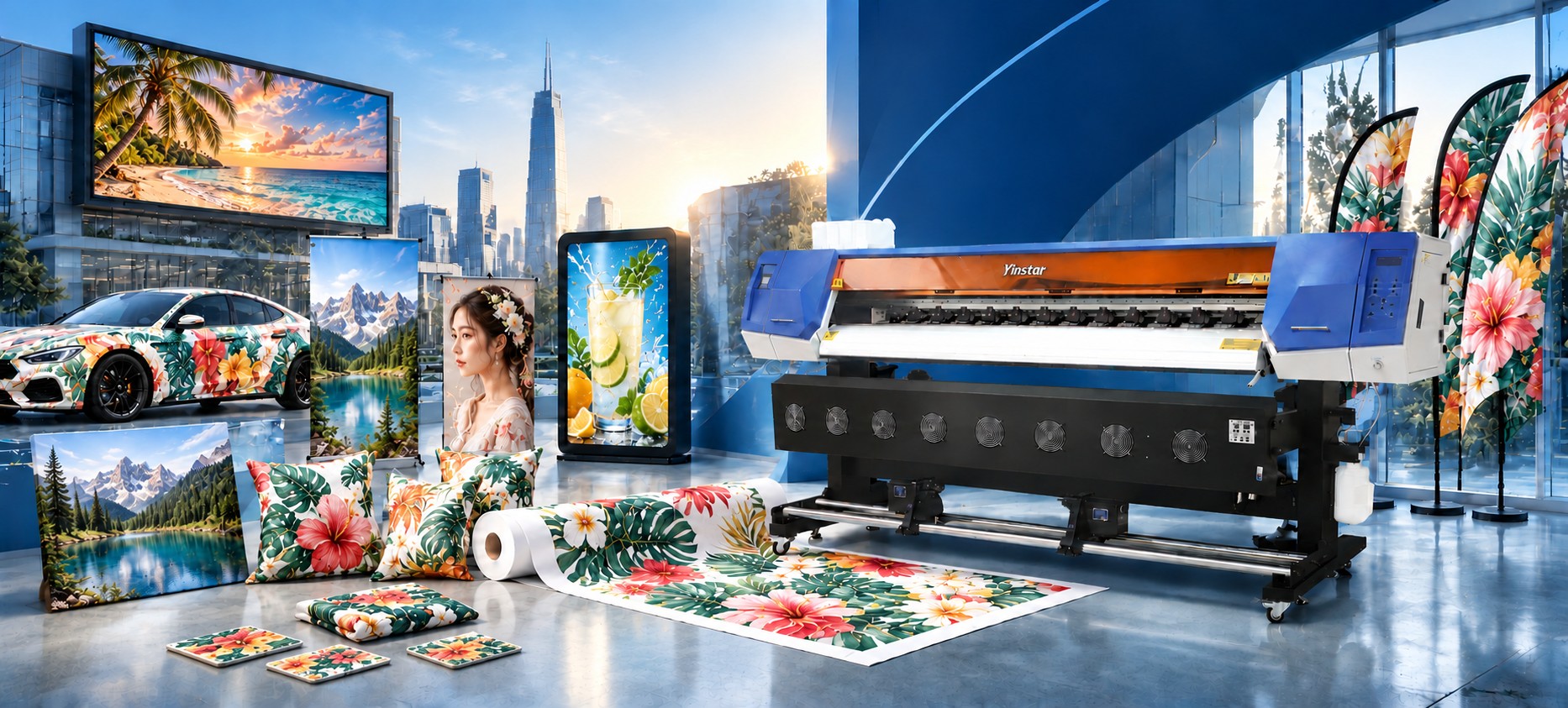
The eight markets below can generate recurring orders rather than one-off jobs. Although they may use similar printing platforms, each market has different priorities: billboard buyers value width and weather resistance, galleries focus on surface texture, and retail chains require consistent colour across multiple locations. Matching the printer to the application is a key factor in determining whether the equipment delivers a reasonable return on investment.
The Eight Application Markets
1. Outdoor signage — flex banners and billboards
The job. PVC flex banners, mesh banners and billboards, usually between two and three metres wide. The print is the finished product: it is viewed from a distance, but it has to survive sun, rain and wind load for the service life specified in the contract.
What it demands. A sufficiently wide print width helps produce a three-metre banner in a single panel, reducing the need for joins. Ink that dries properly through the heating system rather than remaining soft on the roll. And a media/ink combination specified against the service life the client is paying for — the printer determines the output width and drying performance, not the service life.
Machine fit. The YD3200-X5 runs a 3200 mm print width on two Epson i3200 heads, with front and rear two-stage heating and an anti-collision device protecting the carriage across wide media. Flex banner is on its supported media list.
2. Vehicle graphics — wraps and fleet livery
The job. Full wraps over curved panels and deep recesses, partial wraps, and fleet livery repeated across identical vehicles delivered over weeks.
What it demands. Vinyl that stretches without cracking at the edge or leaving white stress marks. Consistent colour reproduction from the first van to the twentieth — which depends as much on colour profiles and ink management as on the printer itself. Fine gradients without banding. Cast vinyl is also thin enough to lift where the panel curves, so media hold-down matters as much as ink: a high-precision suction platform keeps it flat across the platen without the pressure marks a mechanical hold-down leaves.
Machine fit. Car sticker is a listed medium on the YD3200-X5, and the YD7212-3 covers narrower wrap work at a 1950 mm maximum print width. Both can support consistent colour reproduction when used with suitable ICC profiles and properly adjusted density curves.
3. High-end advertising — photo paper and roll-up banners
The job. Graphics viewed at arm’s length: trade-show roll-ups, retail point-of-sale posters, exhibition stands, cosmetics displays.
What it demands. Crisp small text, smooth skin tones, no banding in a gradient sky. Indoor placement also means odour and touch-dry behaviour matter — a print that is still tacky when it is installed in a display stand is a complaint waiting to happen.
Machine fit. Close-range work is usually a width decision before a speed decision. The YD7132-3 is a 1.3 m eight-colour high-precision printer built for this kind of output; the YD3200-X5 handles the large-format version of the same job on photo paper and PP paper.
4. Illuminated displays — backlit film and light boxes
The job. Film illuminated from behind by LEDs: airport and metro light boxes, menu boards, cinema poster cases, boutique window displays.
What it demands. Ink density. A print that looks correct on the table turns pale as soon as it is placed in front of a strong backlight, and any uneven coverage becomes a visible hotspot. This is the application where density and pass mode matter more than headline speed.
Machine fit. Light film is on the supported media list of the YD3200-X5. Because backlit evaluation depends on the actual film and LED output, the practical step is a test print on your own stock rather than a demo roll.
5. Interior décor — wall murals and textured wallpaper
The job. Bespoke murals, hotel and office feature walls, textured wallpaper for renovation projects.
What it demands. Seam alignment across multiple drops on a wall that is never perfectly flat. A wipe-clean surface that does not damage the printed image. And low odour, because the room is usually occupied.
Machine fit. Wallpaper is a listed medium on the YD3200-X5, and a 3200 mm width reduces the number of drops per wall — which helps reduce common alignment problems in mural production.
6. Art reproductions — canvas and painting replicas
The job. Gallery-wrapped canvas, replicas of paintings, framed artwork for hotel and hospitality fit-out.
What it demands. Surface texture, even pigment laydown across the weave, and protection from the failure mode specific to canvas: a warped or curled canvas edge rising into the print carriage. Canvas is expensive and a head strike can cause irreversible damage.
Machine fit. Canvas is supported on the YD3200-X5 and the YD7212-3, and both the YD3200-X5 and the YD8194-3 carry an anti-collision device.
7. Window and floor graphics — one-way vision and floor decals
The job. Perforated one-way vision on shop glazing, anti-slip floor decals in retail and transport environments, promotional window graphics.
What it demands. The micro-perforations have to stay open. Ink pooling in the holes kills the see-through effect and shows as dark speckle from inside. Thin film also has to track flat and stay down on the platen, or it wrinkles under the carriage — which is where a high-precision suction platform earns its place.
Machine fit. The YD8194-3 uses pressure-adjustable pinch rollers, which helps keep thin and perforated film flat through the feed path. Perforated stock should still be test-printed before committing to production.
8. Soft signage and leather — synthetic leather and outdoor flags
The job. PU and PVC synthetic leather for bags, menus and upholstery; teardrop flags and fabric promotional banners.
What it demands. Ink that flexes with the substrate instead of sitting on top of it. Fold a leather panel and a brittle ink layer cracks along the fold — no amount of image quality can compensate for that. Adhesion on a textured surface is another key test.
Machine fit. Leather and light cloth are listed media on the YD3200-X5. The YD7212-3 accepts both eco-solvent and sublimation ink, which matters if the same shop also runs textile work.
Not every job requires a 3.2-metre-wide printer. Here is a dual-head eco-solvent printer working through posters and signage, with adjustable pinch rollers and an integrated drying system:
Matching the Machine to the Market
Width first, then throughput. The four platforms that cover these eight markets differ mainly in how wide they print and how many printheads they use.
- YD3200-X5 — 3200 mm. Two Epson i3200 heads, up to 1440×3200 dpi, front and rear two-stage heating, Hiwin silent linear guides, anti-collision device. Supported media include vinyl, flex banner, canvas, photo paper, PP paper, light film, car sticker, wallpaper and leather.
- YD8194-3 — 1.8 m-class. Four Epson i3200 heads, up to 59 m²/h in 4-pass mode, front, middle and rear three-section heating, pressure-adjustable pinch rollers, anti-collision device. Accepts eco-solvent, sublimation and UV ink.
- YD7212-3 — 1950 mm. Two Epson i3200 heads, 54 m²/h at 2-pass and 31 m²/h at 4-pass, 1.5 L ink bottles, Leadshine servo motors. Accepts eco-solvent and sublimation ink.
- YD7132-3 — 1.3 m, eight colours. High-precision printer for close-range photographic output.
What to Verify Before You Buy
- Test on your own media. Demo media may not fully represent production conditions. Your actual production media and your client’s backlit film are the only relevant tests.
- Get the service life in writing, as a combination. Outdoor durability is set by the combination of ink, media, lamination, environment and application method. Ask for the specific combination that meets the number your contract requires, rather than relying on a single durability figure for the printer.
- Measure your widest recurring job, not your widest possible job. A 3.2 m platform used mainly for 1.2 m-wide jobs consumes additional floor space and power every day.
- Check the electrical load. The YD8194-3 draws 1,900 W for the printer plus 7,400 W for the heater; confirm supply capacity and a dedicated circuit before delivery.
- Budget the RIP. Maintop is supplied free on these platforms; Photoprint is a paid option. It belongs in the total cost, not in the surprise column.
FAQ
What is eco-solvent printing best for?
Durable graphics on vinyl, flex banner, canvas, photo paper, PP paper, backlit film, wallpaper and synthetic leather — indoor and outdoor work where the printed surface has to survive handling and, outdoors, weather.
Do I need to laminate the output?
It depends on the service life and abrasion the job requires. Lamination adds protection and changes the finish; for short-life indoor work it is often unnecessary. Decide per application, not per shop.
How wide should my first machine be?
Match it to the widest panel you regularly print. If billboards and three-metre banners are routine, a 3200 mm platform removes tiling entirely. If your work is close-range indoor graphics, a 1.3 m eight-colour machine buys quality where a wide machine buys width.
Can one machine run both solvent and textile work?
The YD8194-3 accepts eco-solvent, sublimation and UV ink, and the YD7212-3 accepts eco-solvent and sublimation ink, so a single machine can cover both solvent and textile work. That flexibility is useful for a shop serving both signage and soft-signage customers.
If you are selecting a printer for one of these eight markets, tell us about your application, the media you plan to use and the widest panel you regularly print. We can then recommend a suitable platform, printhead configuration and ink-and-media combination.
Browse the full eco-solvent printer range, or talk to us about your application.