Industry Overview
Product Definition and Classification
A digital textile printer is a textile printing device that uses digital inkjet technology to accurately transfer design patterns onto various fabrics via sublimation ink. Among these, sublimation printers, as the mainstream technical route, use high temperatures to penetrate dye into polyester fibers, producing high-quality printed effects that are vibrant, wash-resistant, and long-lasting without fading.
Digital textile printers can be classified according to multiple dimensions:
| Classification Standard | Sub-type | Description |
| Technical Route | Sublimation Inkjet Printing | Suitable for polyester and blended fabrics; market mainstream |
| Direct-to-Garment (DTG) | Prints directly onto finished garments; suitable for cotton | |
| Direct-to-Fabric | Roll-to-roll continuous fabric printing | |
| Machine Specification | Industrial-grade Printer | High-speed, high-volume production |
| Large Format Printer | Wide-format home textile and advertising applications | |
| Small Desktop Printer | Sampling, small-batch customization | |
| Printing Mode | Scan (Multi-pass) | High precision, slower speed |
| One-pass | One-time formation, extremely fast |
Industry Chain Structure
The digital textile printer industry chain mainly includes:
- Upstream: Printheads (Epson), Inks (sublimation), Control Systems (RIP software), Drive Components
- Midstream: Complete Machine Manufacturing (Brand owners, OEM manufacturers)
- Downstream: Apparel, Home Textiles, Soft Signage, Personalized Customization, Technical Textiles
Market Size and Growth Forecast
Global Market Overview
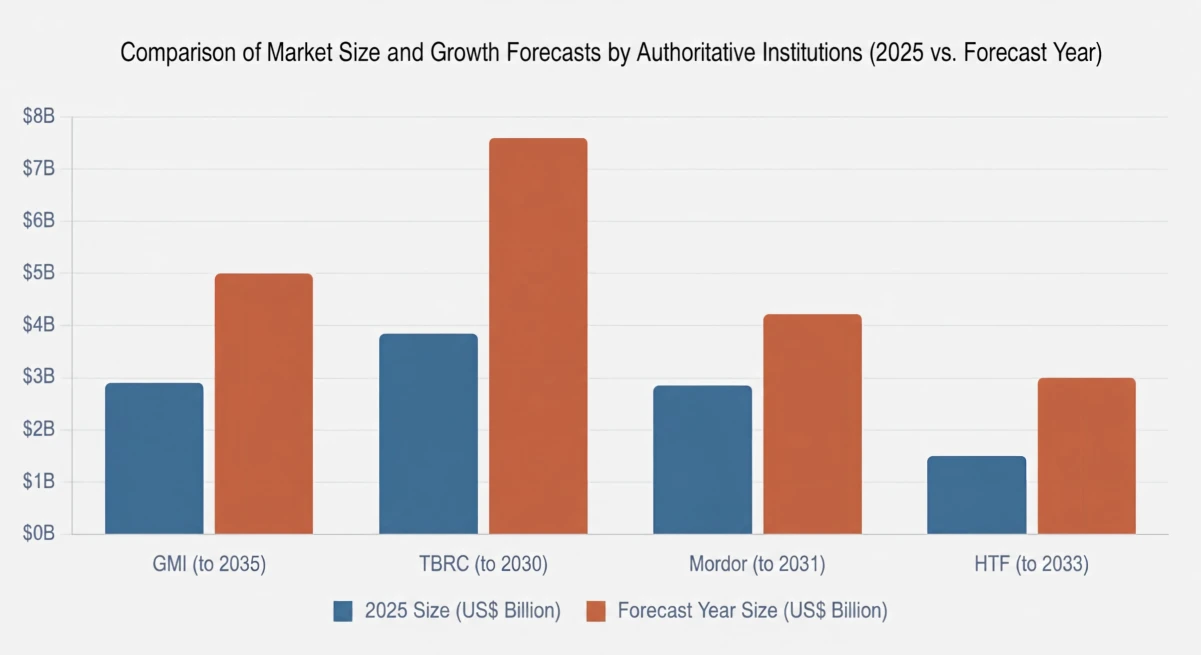
The digital textile printing market is in a phase of rapid growth. According to multiple authoritative institutions:
Comparison of Data from Multiple Institutions
Regional Market Analysis
Asia-Pacific – The World’s Largest Market
The Asia-Pacific region holds approximately 42% of the global market share. Within this region:
China: The world’s largest textile producer and exporter, holding ~20.7% of the global market share in 2025. China is actively promoting green manufacturing policies, accelerating the transition from traditional printing and dyeing to digital textile printing.
India: Promoting digital textile printing adoption through the PM MITRA mega textile parks scheme, with US$2.2 billion in incentive measures.
North America – Technologically Leading
The US market size in 2025 was approximately US$370 million, expected to grow at a CAGR of 4.6%.
Leading brands like Epson, Mimaki, and Roland dominate the market.
The “Made in America” reshoring trend is driving localized production.
Europe – Driven by Environmental Compliance
EU ESPR regulations are driving the textile industry towards low water consumption and environmentally friendly printing.
Germany, as the European textile machinery hub, leads Industry 4.0 integration.
Middle East & Africa – Fastest Growing
Expected to grow at a CAGR of 10.75%, the fastest globally.
UAE and Saudi Arabia attract textile investment through free zone incentive measures.
Market Driver Analysis
Main Driving Factors
Surge in Demand for Personalization and “Small-batch, Fast-fashion”
Increasing consumer demand for personalization is pushing brands from “mass standardization” towards “small-batch customization.” Digital textile printing technology enables one-click design changes and printing from one piece onward, significantly reducing inventory risk and capital tie-up.
Expansion of E-commerce and DTC Models
US e-commerce sales in Q2 2024 reached US$291.6 billion, a year-on-year increase of 6.7%, accounting for 16% of total retail sales.
The popularity of Print-on-Demand (POD) models directly drives procurement demand for digital textile printing equipment.
Environmental Regulations Drive Technological Substitution
Traditional printing and dyeing consumes 50-60 liters of water per meter of fabric, while digital textile printing can reduce water usage by up to 90%.
Environmental policies such as EU REACH regulations and China’s “Dual Carbon” goals are accelerating the replacement of traditional processes and the adoption of digital technology.
Printhead and Ink Technology Innovations
One-pass printing technology increases speed by 10-20 times.
Maturation of water-based pigment inks and waterless flatbed technology expands application scope.
AI-driven color management systems improve yield rate and consistency.
Fast Fashion Production Cycle Requirements
Fast fashion brands (e.g., ZARA, SHEIN) require a 2-4 week turnaround from design to shelf.
Digital textile printing eliminates the plate-making step, shortening delivery lead time from the traditional 1-2 months to just a few days.
Constraints and Challenges
| Challenge Factor | Specific Manifestation | Impact Level |
| High Initial Investment | Industrial one-pass machines cost US500,000–US500,000–US2 million; difficult for SMEs to afford | ★★★★ |
| High Consumable Costs | Inks and transfer paper can account for 40-60% of operating costs | ★★★☆ |
| Shortage of Technical Talent | Equipment and color management require specialized skills | ★★★☆ |
| Competition from Alternative Processes | Traditional screen printing still has cost advantages for very large batches | ★★☆☆ |
| Raw Material Price Fluctuation | Ink raw material prices are affected by the petroleum market | ★★☆☆ |
Market Segmentation Analysis
Segmentation by Technology Type
| Ink Type | Market Share (2025) | CAGR | Characteristics |
| Sublimation | 41.88% | 9.12% | Vibrant colors, high durability, best for polyester |
Segmentation by Printing Mode
Segmentation by Application Area
| Application Area | Share | Growth Trend |
| Apparel | Largest | Driven by fast fashion, DTG growth |
| Home Textiles | Second Largest | Strong demand for curtains, bedding, carpets |
| Soft Signage | Fast-growing | Increasing demand for events, exhibitions, store decor |
| Promotional Products | Emerging | Expanding market for gifts, customized products |
Competitive Landscape and Major Players
Market Competition Landscape
The competitive landscape of the digital textile printing industry is as follows:
Leading Brands Dominate: The top 10 global companies hold the major market share; market concentration is moderately high.
Differentiation in Segments: Japanese companies dominate printhead technology (Epson, Kyocera); Israel’s Kornit focuses on DTG; Chinese companies like Atexco and Hans are rapidly rising in the mid-range market.
Business Model Transformation: Equipment manufacturers are shifting from hardware sales to “equipment + ink + service” one-stop solutions.
Industry Development Trends
Technology Trends
One-pass Printing Proliferation: One-pass technology increases speed by 10-20 times, penetrating from the advertising sector into textiles.
AI and Automation Integration: AI color management, predictive maintenance, and cloud monitoring are becoming widespread.
Eco-friendly Ink Innovation: Water-based, PFAS-free, and biodegradable inks are R&D focuses.
Miniaturization and Micro-factories: Small and medium-sized equipment meets localized, on-demand production needs.
Business Model Trends
Print-on-Demand (POD): Eliminates inventory risk, adapts to personalized consumption.
Micro-factory: Localized small-scale production, reducing logistics costs.
Reshoring: Europe and the US shifting capacity from Asia to shorten supply chains.
Application Area Trends
Smart Textiles: Printing on smart fabrics for medical, automotive, and sports sectors.
Circular Economy Textiles: Combining recycled fibers with digital printing.
High-end Customization: Wedding dresses, luxury goods, designer collaborations.
Summary and Outlook
Core Insights
Implications for Chinese Enterprises
Outlook for 2030
By 2030, digital textile printing is expected to account for 15-20% of total global textile printing volume (currently ~7-8%). One-pass printing, AI automation, and eco-friendly inks will become industry standards. The textile industry will completely transition from a “mass production, low cost” model to a “flexible, intelligent, green” model.